


Sample documents for artists
 Art DomJune 16, 2026
Legal literacy is just as much a tool for a modern artist's success as high-quality brushes, canvases, or paints. In this article, we have gathered the most popular legal documents that professional artists need to reliably protect their rights, freedoms, and financial interests. All templates have been prepared by experts, drawing on current trends in the contemporary art market and the real needs of both creators and collectors or art dealers. Our materials and every standard contract with an artist are drafted fully in accordance with the provisions of the Civil Code of Ukraine, the specialized Law of Ukraine "On Copyright and Related Rights," as well as key norms of international law (in particular, the Berne Convention).
Legal primer for the artist: what you need to know before signing documents?
Many emerging authors make a critical mistake, believing that the sale of a physical canvas automatically deprives them of all rights to the work. Ukrainian and international legislation clearly separates the right of ownership of a material object (the painting itself) and the intellectual property rights to its visual image. When concluding any artist contract, one must clearly distinguish between two basic types of rights:
- Exclusive moral rights — this is the inalienable right to be recognized as the author of the work, to prohibit the mention of one's name (anonymity) or, conversely, to demand its proper attribution at every exhibition or in a catalog, as well as the right to oppose any distortion, alteration, or other derogatory action in relation to the painting that could harm the author's reputation. These rights remain with you forever: they cannot be sold, gifted, or transferred by contract to other persons.
- Economic rights — this is the exclusive right of the author to allow or prohibit the use of the work by other persons (digital reproduction, merchandise multiplication, use in advertising, creation of prints, etc.). It is these rights that are the main subject of commercial deals, and any contract for copyright, related rights delegating their use must be concluded exclusively in written form.
Regardless of whether a one-time deal with a collector is being formalized, or a large-scale artist-gallery agreement on long-term representation is being prepared, putting the terms on paper is the only way to avoid grueling legal disputes in the future. Below you will find practice-tested, legally verified templates, sample documents for artists that you can download for free and adapt to your own tasks.
The presented document samples are ready-made forms that users can download, copy, and make necessary adjustments for further use. If you need a personalized approach, a specific contract for commissioning paintings from an artist (a commission agreement for the creation of a future work) or professional consultation in the field of intellectual property rights, civil and commercial litigation, legal support — contact the consultants of the ArtDom gallery.
Authorship confirmation for a work of art
A popular request to artists from buyers is — "do you provide a document confirming your authorship along with the painting?". According to the Berne Convention and Art. 11 of the Law of Ukraine "On Copyright and Related Rights", a presumption of authorship applies. Copyright arises at the moment of the work's creation and does not require any formalities (neither passports nor registrations). That is, a handwritten document with the artist's signature already has legal force as a statement or receipt.
From the point of view of civil law, a written document from the artist on a letterhead or simply handwritten on paper will be sufficient. The main thing is that this expression of will has legal force. For this, the artist must record the following data:
- Full name of the artist;
- title of the work of art (painting, graphic work, sculpture);
- year of creation;
- materials and technique;
- dimensions;
- copy number, if the item was part of an edition;
- date, city of signing, personal handwritten signature (not a facsimile);
- passport details — not strictly necessary, but desirable to identify the person in civil legal relations (to prove that this Artist is exactly the same Artist as in the passport, and to avoid fraud).
You can download the Authorship confirmation form via the link in docx format.
Certificate of authenticity
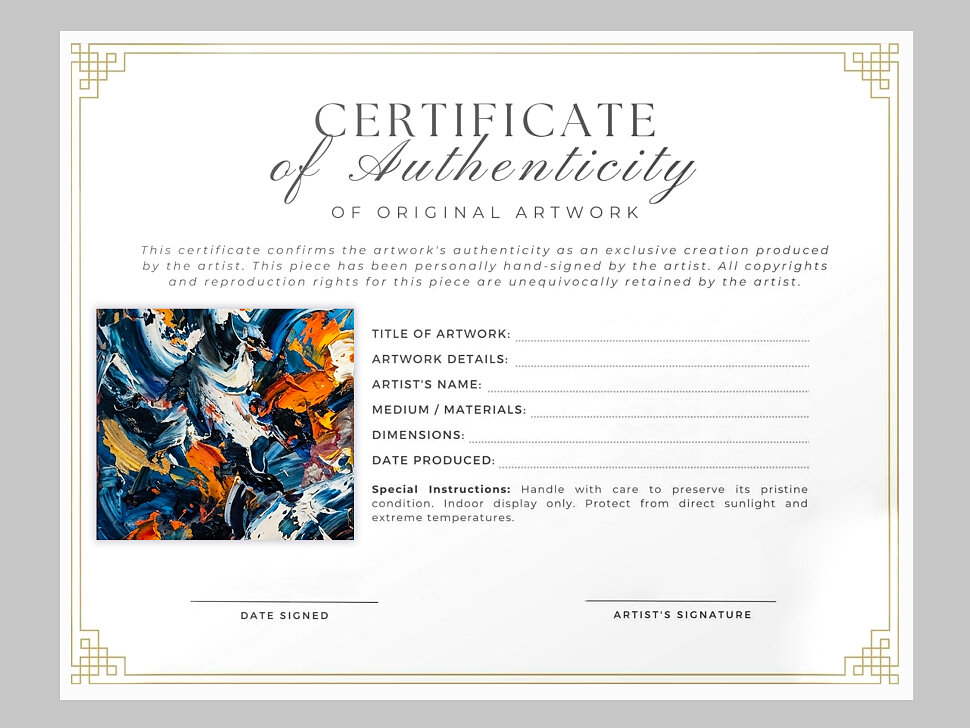
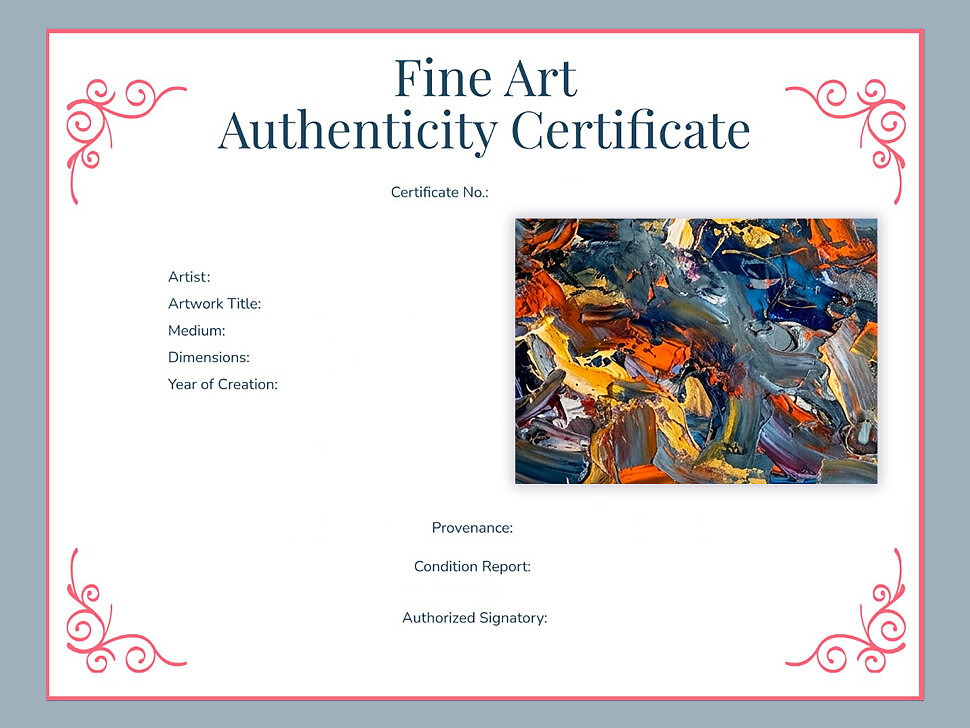
A slightly modified form of authorship confirmation that has a more presentable cover. Professional painters, graphic artists, and sculptors produce certificates themselves on their own letterhead or order them in galleries. The latter option emphasizes the fact that the artist collaborates with an art dealer who promotes their work.
Artists often develop their own certificate design to clearly stand out among other artists and be remembered by the buyer. This increases the chances of a repeat sale, as collectors remember such details. Below we have attached certificate templates that you can modify and edit using graphic editors to your liking.
 |
 |
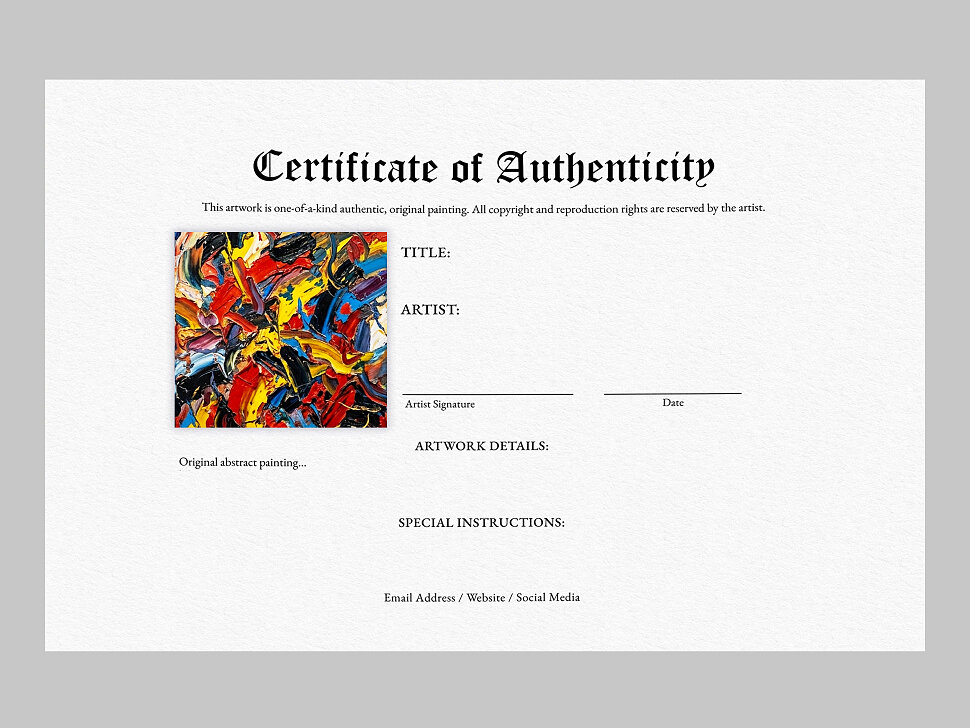 |
Download the Certificate of Authenticity form via the link in docx format.
Create a certificate of authenticity for free in the online editor from the ArtDom gallery via the link.
Or order a custom certificate of authenticity for a work of art with a hologram from the ArtDom gallery via the link.
Purchase and sale agreement and commissioning of paintings
An important document in the art market that helps the parties avoid disagreements and coordinate all the terms of the deal on paper. This document regulates the transfer of ownership of the physical object — the canvas itself, the stretcher, and the paints. It is the main legal guarantee that the buyer becomes the legal owner of the material item, and the artist receives the agreed remuneration on time and in full. Note that if the work is created from scratch to the specific requirements of the client, the parties sign an extended contract for commissioning paintings from an artist, which separately records deadlines, sketches, and stages of prepayment. When agreeing on the terms of the contract, the artist can sell the painting as a material object, and can also transfer intellectual property rights to the buyer.
The form for the Purchase and sale agreement of a painting with an acceptance and transfer act is available via the link.
Exhibition agreement (artist's contract for an exhibition)
A well-drafted artist's contract for an exhibition is the main shield against the most common risks of the art market: accidental damage to the work during the exhibition, in case of theft, unauthorized commercial use of its image, or delay in returning the artwork to the owner. It turns verbal "gentlemen's" agreements with art spaces into clear legal obligations. The document details every step: from transportation and installation rules to insurance terms, premises security, and commission payments in the event the painting is sold directly from the exhibition hall.
Therefore, when handing over a work of art to be showcased at an exhibition or art fair, the artist has the right to demand the signing of a contract to record such details:
- establishing the fact of transferring the painting(s) for temporary use for a certain period of time;
- the purpose of the exhibition — presenting the artist's work with the mandatory indication of the artist's surname and first name and/or creative pseudonym, demonstration for sale at an agreed price;
- the condition of the painting (presence or absence of damage, characteristic features);
- exhibition conditions (for example, indoors or outdoors, on a pedestal or in a frame on the wall, with additional lighting, etc.).
If the exhibition takes place in Ukraine, you should also consider the option of accident insurance. The art space must exhibit the works in a safe location, provide proper conditions for exhibition, security of the premises, and have a functional fire extinguishing system.
The form for the Exhibition agreement with an acceptance and transfer act is available via the link.
Copyright transfer agreement (author's agreement)
Most buyers of paintings think that by purchasing a painting, they automatically acquire the copyright to this work of art. But this is possible only if it is provided for by the terms of the contract between the author of the painting and the buyer. An exception is works of art that are in the public domain. According to the Law of Ukraine "On Copyright and Related Rights" (Art. 30), works for which the term of copyright has expired (70 years after the death of the author) pass into the "public domain". When a painting enters the public domain, it can be freely and free-of-charge used by anyone for commercial purposes, but with the mandatory preservation of the author's name and the integrity of the work itself.
According to the current legislation of Ukraine, economic copyrights are transferred exclusively in written form. This contract is the only legal instrument for a buyer who plans to use the image of the painting for commercial, advertising, or public purposes. The text of the document must explicitly detail the specific methods of use (for example: printing on clothes, use in packaging design, digital marketing), the territory of the agreement's validity, and the timeframes.
Copyrights give their owner the following capabilities:
- Multiplication of products with the image. For example, placing an image of a painting or a fragment of it on water bottles. Or printing an image of a painting or its fragment on t-shirts.
- Placing an image of a painting in the internet space, in book publications. For example, the copyright owner can publish a book where the paintings will act as illustrations.
- The ability to modify the image. For example, creating a cross-stitch pattern for a painting with such an image.
You can download the form for the Copyright transfer agreement via the link.
The indicated documents are an important part of the artist's legal life and require attention to detail. Therefore, carefully research the issue of protecting your own rights and interests. If you need help — contact the consultants of the ArtDom gallery.