



How to create an Invoice for the sale of a work of art?
 Art DomMarch 2, 2025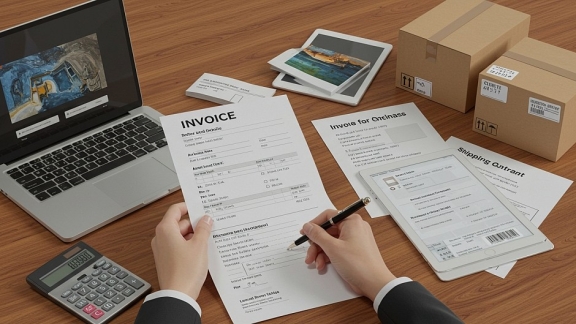
Invoice (invoice, bill of sale) – is a document based on which the buyer transfers funds for the purchase of a work of art. This document specifies all the details of the transaction: a description of the artwork, information about the seller and the buyer, the delivery address, price and payment terms. Without a properly issued invoice it is impossible to legally sell a painting abroad, complete customs clearance or insure the work during transport.
Good news: a professional invoice for a work of art can be created in 2‑3 minutes using our free invoice generator – it is specially designed for artists and galleries, and generates a document in the format required by international customs with all the mandatory fields. In this article we will examine why a proper invoice is needed, what elements it should include, what services exist, and we will also show the types of invoices, country‑specific features and the top mistakes when completing them.
What is an Invoice and why does an artist need it
An invoice (from Eng. “bill”) is a commercial document issued by the seller to the buyer that records the terms of the transaction. In the art sphere an invoice performs several critically important functions:
- Basis for payment. The buyer transfers money based on the invoice – it is their working document for payment.
- Document for customs. When shipping internationally, the invoice is placed in the parcel – the customs of the receiving country use it to calculate duties.
- Basis for insurance. The amount of the insurance policy cannot exceed the value indicated in the invoice.
- Proof of the legality of the transaction. During a tax audit the invoice proves that you have legally received funds from the sale of the work.
- Protection against disputes. If claims arise (damage, mismatch with the description), the invoice becomes the basis for negotiation or court proceedings.
In the field of art and antiques, a correctly drawn up invoice plays a key role, because it not only confirms the fact of sale but can also serve as an important document for customs clearance, accounting operations and insurance of works. Without proper “art invoice registration,” owners may find it difficult to track the movement of valuables, prove the origin of a work or resolve controversial issues related to copyrights and the condition of works. The creation of an invoice for art is especially relevant in the context of international transactions, when detailed information about the author, technique and estimated value must be presented as transparently as possible.
Why it is important to create the right invoice for works of art

Preparing an official invoice for works of art is not just a formality but a powerful mechanism for protecting the interests of both the seller and the buyer. First of all, such a document serves as the basis for legal and financial transparency. In the art sphere there are quite often situations when the lack of a clearly drawn up invoice becomes the cause of disputes related to ownership, provenance or price justification of works. When the invoice is drawn up according to all standards, it allows you to confirm the legality of the transaction and avoid accusations of illegal trafficking of cultural values.
In addition, a correct bill for the sale of a painting or sculpture helps ensure ease of interaction with tax and customs authorities. For example, when exporting or importing works of art, documents often require detailed description of the work, indication of the estimated value and information about the author. If the invoice contains all these details, the procedures of verification and registration go faster and with minimal delays. This is especially important for galleries that exhibit and sell artists’ works at international exhibitions, as well as for private collectors who constantly buy and sell valuable art objects.
Another important aspect is payment security. The presence of a correctly drawn up bill increases trust in the seller and facilitates the settlement of financial calculations. The buyer, upon receiving the invoice, understands that the funds will be sent in accordance with legal requirements, and in case of claims or disputes (for example, due to poor packaging or discrepancy with the declared condition) the invoice becomes the basis for further negotiations or legal proceedings. Thus, the correct preparation of documents, among which an invoice for art occupies an important place, helps owners of works, artists and buyers to be confident in the legal protection of their transactions.
Types of invoices: Commercial Invoice vs Pro Forma Invoice
Many artists do not know that there are two main types of invoices, and each is used in its own situation. Choosing the wrong type is a common reason for rejection by customs or the bank.
- Pro Forma Invoice (preliminary invoice) – this is an offer or invitation bill. It is used when the seller describes the conditions of a future transaction, but payment has not yet been made. The buyer looks at the Pro Forma, makes a decision and then the seller issues the final document.
- Commercial Invoice (commercial invoice) – this is the final document that records the fact of sale. It is this one that is placed in the parcel for customs, it is used by the buyer to pay, and it is checked by the tax authorities. This is the “main” invoice that is usually meant.
For an artist selling a work abroad, you need exactly a Commercial Invoice. In our invoice generator it is the commercial invoice that is generated with the fields required for international customs.
There are a few other varieties: a Customs Invoice (contains expanded information for specific countries, for example the USA), a Consular Invoice (for some Latin American countries) and a Tax Invoice (with VAT, for registered VAT payers in Ukraine). For most artists when sending works abroad, a standard Commercial Invoice is sufficient.
Top‑3 online services for generating invoices for works of art
In the digital age you can create a professional bill (invoice) literally in a few minutes using specialized online platforms. They provide templates and tools that allow you to quickly enter all the necessary data about the seller, buyer and the work itself. Below are the top three most convenient services that will be useful for artists, collectors and galleries.
1. Service from ArtDom – invoice generator for artists and galleries
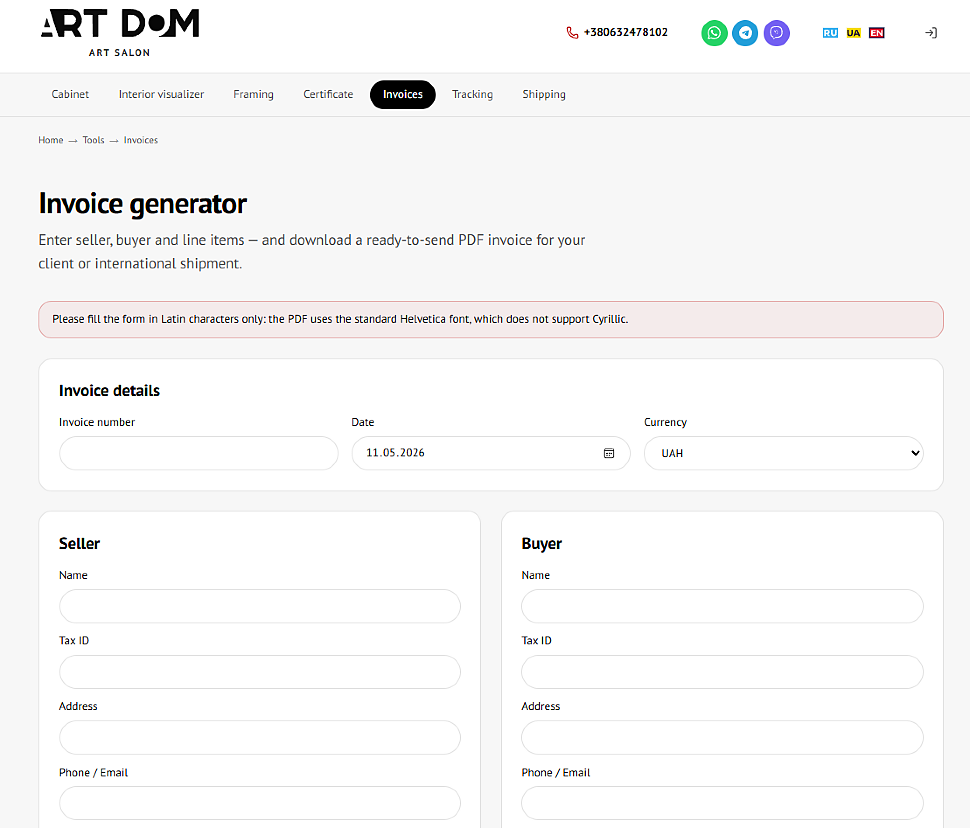
➦ https://artdom.com.ua/tools/ru/invoice – free, no registration
This is a specialized resource focused precisely on the needs of the art market. Unlike universal generators, our service initially takes into account the specifics of selling works of art – the author, technique, dimensions, material and estimated value. It offers flexible templates for different types of works – from paintings and sculptures to icons and decorative art objects. Thanks to this you can easily customize the description of the work taking into account the technique, materials and sizes, as well as specify the price in several currencies (USD, EUR, GBP).
An additional advantage is that the figures in the invoice automatically synchronize with the customs declaration and export permit if you order these services from the ArtDom gallery. This eliminates the risk of error – all documents will contain the same estimated value, which is critically important when passing through customs. The interface remains intuitive and does not require special knowledge in accounting. The finished PDF can be downloaded or immediately sent to the buyer by email.
2. Invoice‑generator.com
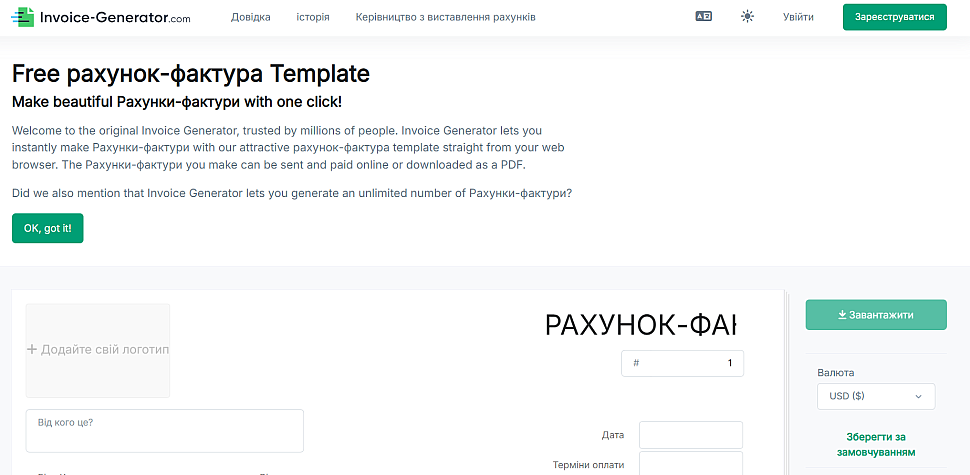
➦ https://invoice-generator.com/
A universal service aimed at a wide range of users. Its advantage is the ease of use and quick formation of documents that can be shared in PDF format or sent via a link. In addition, the resource supports Ukrainian, Russian and English interface languages, which allows you to easily draw up an official bill for international buyers. If you need a basic invoice with a minimum of additional parameters, this service is perfect – it does not require registration.
Minus for an artist: it does not take into account the specifics of the art market – there are no fields for the author, technique, year of creation or estimated value. You will have to enter this information in the general “description” field, which is not always convenient for customs.
3. Aftership.com
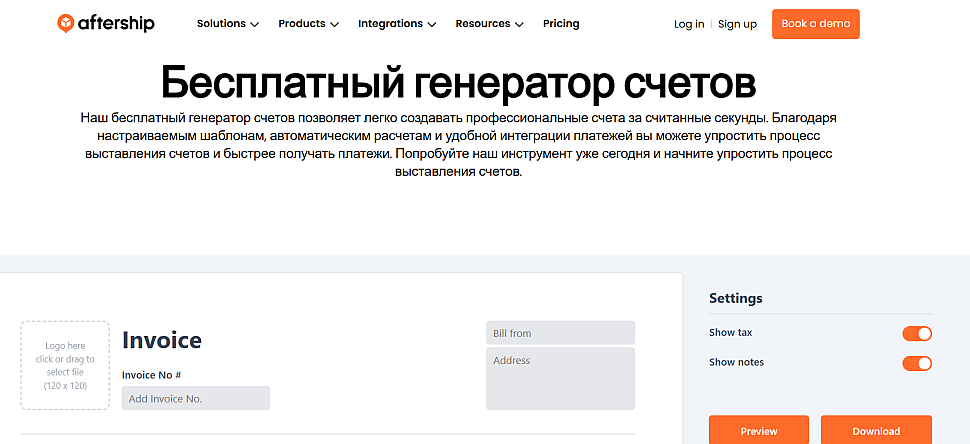
➦ https://www.aftership.com/tools/invoice-generator
The platform is better known for its parcel tracking capabilities, but it also provides a convenient tool for creating invoices. In a few minutes you can add to the template information about the work, its quantity, price and additional conditions. An advantage is the support of numerous integrations with marketplaces and payment systems. If your activity involves regular shipments of works of art abroad, this service will simplify the management of both logistics and financial documentation.
Main elements of an invoice for paintings, sculptures and icons

For the “art invoice” to be complete and comply with international practice, it is important to include several key components:
1. Invoice number and date. Each invoice has a unique number (for example ART‑2026‑001) and the date of issue. This is necessary for accounting and tracking.
2. Seller details. Full name of the artist or the name of the gallery, legal and mailing address, phone, email. For registered VAT payers – the tax number.
3. Buyer details. Full name of the buyer or the name of the recipient company, delivery address, contact number, email. For companies – EIN (USA), EORI (UK), VAT number (EU).
4. Description of the artwork. A critically important point. Must include: the author, title of the work, year of creation, technique (oil on canvas, acrylic, sculpture in bronze, etc.), dimensions in centimeters, estimated value. For sculptures – the material and weight.
5. Price and currency. A clear amount and currency (USD, EUR, GBP). For international shipments the amount must match the export permit and customs declaration – this is critically important.
6. Payment terms and deadlines. A standard wording is: “Payment within 14 days from the invoice date.” If there is an advance, indicate its amount.
7. Payment details. Bank account (IBAN), SWIFT code of the bank, name of the recipient bank. You can add a PayPal address if you use this system.
8. Delivery terms. Who pays for delivery (INCOTERMS: EXW, FOB, DAP, DDP), who is responsible for insurance, whether there are special packaging requirements.
9. Signature. Signature of the seller (physical or electronic). In international practice an electronic signature on a PDF is equivalent to a physical one.
10. HS Tariff Code (UKTZED code). As of April 18, 2024 – a mandatory field for international shipments from Ukraine. For an original painting – 9701 10 00 00, for a sculpture – 9703 00 00 00. For more details, see our article on UKTZED codes.
The invoice in the chain of documents for international shipping
The main thing to understand is that the invoice is not a standalone document but part of a chain where all amounts must match. When shipping a work of art internationally from Ukraine you will need:
- Export permit from the Ministry of Culture (expert conclusion). The estimated value is indicated.
- Invoice – the amount that is in the export permit.
- Customs declaration CN23 or MD‑2 – the same amount.
- Insurance policy – the same amount (this is the maximum that the insurance will pay).
If at any stage the figures differ, customs will delay the parcel until clarification and the insurance company will refuse payment in case of damage. Therefore it is most convenient to prepare all documents in one place so that the values automatically match.
Related materials on our site:
- What documents are needed to send paintings abroad
- How to fill out a customs declaration
- Estimated value of works of art
- UKTZED codes for international parcels
How to create a professional invoice: step‑by‑step instructions

To make the process of creating an invoice seem less complicated, follow this algorithm:
Step 1. Collect basic information. Who is selling the work (artist, gallery, owner of a private collection) and who is buying it (individual, institution, international customer). Prepare the full names and addresses of both parties.
Step 2. Prepare a description of the work. It is important to indicate the title, technique, dimensions, materials, year of creation and other details that confirm the uniqueness and value of the object. If there is a certificate of authenticity or a note about exhibition history, it is worth mentioning this in the invoice or adding it as an attachment.
Step 3. Form the price and payment terms. Specify a clear amount and currency, as well as details regarding taxes, duties and commissions that may relate to the “sale bill for a painting.” If the transaction is international, add information about the seller’s banking details to avoid confusion.
Step 4. Specify payment deadlines. For example: “Payment must be made within 14 days from the invoice date.” This allows you to regulate the terms if payment is delayed.
Step 5. Delivery and insurance terms. It is worth specifying who is responsible for logistics (the seller or the buyer), who pays the costs of packaging and shipping, and whether insurance is included in the price. It is always appropriate to clarify whether special delivery conditions are required (climate control, accompanying documents for customs, etc.).
Step 6. Check all data and send the invoice to the buyer. When using online services be sure to look at the preview of the document or download the PDF version to make sure there are no mistakes. Only after that can the “art invoice registration” be considered completed.
Country‑specific invoice features
Each country has its own nuances for invoicing. The values below are relevant for 2026.
- USA. Duty‑free threshold of $800 (de minimis). For a commercial recipient it is mandatory to indicate the EIN. The description of the work should be detailed – “Original oil painting” rather than just “Painting.” Amounts over $2500 require extended documentation and submission through a broker.
- Germany. Duty‑free threshold of €150. VAT 7 % for original art. The invoice requires specifying the author and year of creation exactly – without this the reduced rate will not apply.
- France. Duty‑free threshold of €150. VAT 5.5 % for original art. French customs like detailed descriptions – author, biography, exhibition history.
- United Kingdom. Duty‑free threshold of £135. After Brexit – a separate procedure. The recipient company needs an EORI number. VAT 5 % for original art.
- Canada. Duty‑free threshold of CAD 20 (for gifts – CAD 60). Strict requirements – you need to attach a certificate of authenticity or an expert opinion.
- Poland. Duty‑free threshold of €150. Ukrposhta discount up to 70 % on delivery. The most convenient route for artists from Ukraine.
Invoice preparation features: tips and recommendations
Firstly, pay attention to visual design. Although the bill must be legally clear, in the art sphere aesthetics are also appreciated. Adding the gallery’s logo, an image of the painting or icon or corporate style gives the document individuality and authority. However, do not overload the invoice with unnecessary graphics, as this can make it harder to read and further use in tax and customs services.
Secondly, consider that different countries may have specific invoice requirements. For example, in some jurisdictions it is necessary to indicate the tax numbers of the seller and the buyer, in others separate barcodes or references to regulatory documents may be required. Before drawing up an invoice, especially if you are selling a work abroad, be sure to find out local legal nuances. This will help avoid annoying delays in shipping and possible fines.
Thirdly, think about the optimal way to store invoices. Electronic services usually allow you to store documents in the cloud, make backups and quickly find the necessary invoice by tags or dates. It is also recommended to keep at least one copy (file or printed version) in your own archive so that in case of problems with the service or a dispute you have proof at hand. If you often buy or sell works of art, creating a system for accounting and archiving will save you time and nerves.
Finally, keep confidentiality in mind. The invoice may contain personal data of the buyer as well as information about the price of the art object that you do not always want to disclose publicly. Therefore ensure reliable protection of documents, use secure channels for transmission and avoid storing such files on publicly accessible servers. All this creates favorable conditions for the development of an open and at the same time safe art market.
Top‑5 mistakes when drafting an invoice
In 9 years of work the ArtDom gallery has helped with the paperwork for more than 2000 shipments of works of art abroad. Here are the most common mistakes in invoices that we see:
- The amount in the invoice does not match the export permit or customs declaration. The most frequent and expensive mistake. All three documents must contain the same figure. A discrepancy of even $10 gives customs a reason to hold the parcel for clarification, and the insurance company will refuse to pay in case of damage.
- Cyrillic in the description of the work. International customs accept only Latin letters and the English language. You can leave the title of the work in quotes in Ukrainian, but you must provide an English translation nearby: ""Zakhid sontsia" / "Sunset"".
- The category “Gift” in the presence of an invoice. If an invoice or receipt is in the parcel and the customs declaration indicates “Gift,” this is a contradiction. Customs interpret this as an attempt to hide a commercial transaction. If there is an invoice – the category should be “Other / Sale of artwork.”
- No UKTZED code. As of April 18, 2024, this is a mandatory field for international shipments from Ukraine. Without the code Ukrposhta does not accept the declaration and the parcel may get stuck at customs.
- Vague description of the work. “Painting, $500” is a signal for inspection. Customs will request a detailed description of the author, technique and dimensions. Specify right away: “Original oil painting on canvas, "Sunset over Dnipro", artist I. Kovalenko, 2024, 50×70 cm.”
How the ArtDom gallery helps with invoices
At the ArtDom gallery we have simplified the process of creating invoices to 2‑3 minutes:
- Free invoice generator – no registration, in Ukrainian and English, with fields specifically for the art market (author, technique, year, material, estimated value).
- Automatic synchronization with the export permit and customs declaration if you order a full package of documents from the gallery – one amount in all documents.
- PDF format – the finished document can be downloaded, printed or immediately sent to the buyer by email.
- Templates for different types of works – paintings, sculptures, graphics, icons.
- Currency support – dollars, euros, pounds, hryvnias.
This is an absolutely free service. Just go to https://artdom.com.ua/tools/ru/invoice, fill in the fields and get a ready PDF.
Frequently asked questions
What is an Invoice for works of art?
What information must be in a painting sales invoice?
Which service is best for creating an art invoice?
Do I need to register to use online invoice creation services?
What language should the invoice be issued in?
What is the difference between a Pro Forma Invoice and a Commercial Invoice?
Should the amount in the invoice match the export permit and declaration?
Is a signature required in an electronic invoice?
How to confirm the legality of the transaction using an invoice?
Does the design of the invoice matter for the art market?
How long to keep invoices?
Can I get help with drafting the invoice and other documents?
Our materials on the topic may also be useful:
- What documents are needed to send paintings abroad
- How to correctly fill in the customs declaration when sending art objects
- Estimated value of art objects for delivery abroad
- UKTZED codes for international parcels
- Free invoice generator for artists
Have questions? We will gladly consult you +38 063 247 8102
Or write to us in Telegram, Viber or WhatsApp
You may be interested in the following services of our gallery
Export of paintings abroad (obtaining a permit)
Attribution, expertise (establishing authorship)