
Artificial intelligence for artists: Top 20 AI services for every day
 Art DomMarch 2, 2025
With the advent of various digital art services and the rapid development of artificial intelligence, modern artists have gained new tools for bringing their boldest ideas to life. AI for artists today is not just an additional app or a fashionable whim. It is a real opportunity to simplify workflows, experiment with styles and forms, and open new horizons of creativity.
Thanks to AI art technologies, artists can create unique illustrations, bring concepts for computer games to life, improve image quality and even generate whole virtual worlds. In this article we will look at how artificial intelligence is changing contemporary art, what its advantages are for creative individuals and – most importantly – we will get acquainted with current AI services of 2026, broken down by the artist’s tasks. And finally, we will look at practical cases of integrating artificial intelligence into art workflows and consider the prospects of AI in creativity.
At a glance: what’s new in 2026
In the niche of AI services everything changes every 3–6 months. Here are the key changes that have occurred since 2024:
- Sora 2 by OpenAI and Veo 3 by Google – a revolution in generating video from text or a picture.
- Flux from Black Forest Labs became the best open image generator, surpassing Stable Diffusion.
- Nano Banana (Gemini 2.5 Flash Image) – a new standard for editing images without losing quality.
- GPT‑Image via ChatGPT replaced the outdated DALL‑E 2 – it understands text inside an image and preserves style.
- Krea and Magnific are the new leaders for upscaling and realistic enhancement of images.
- Art platforms (Saatchi Art, Artsy, ArtMajeur) introduced mandatory labeling of AI works.
How artificial intelligence is changing contemporary art
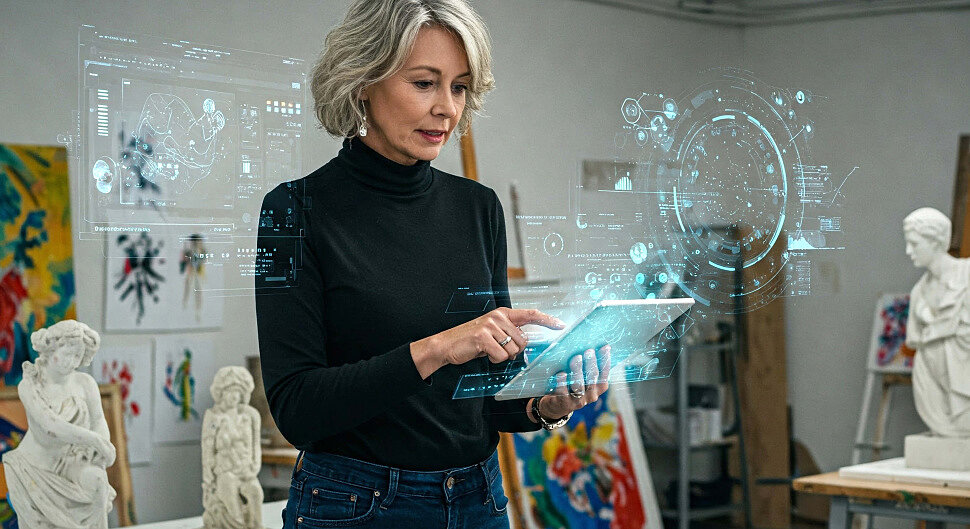
Over the last decade artificial intelligence has fundamentally changed the way artworks are created and perceived. Previously, artists relied mainly on traditional techniques and tools, but now they have access to new digital art services that open up much wider possibilities. Machine learning algorithms and neural networks are able not only to reproduce known styles or analyze existing images, but also to generate unique ideas by rethinking the boundaries of classical art.
Thanks to AI, artists can quickly experiment with different variations of colors, textures and compositions, saving time on routine tasks. For example, neural networks easily turn an ordinary photo into a piece in the style of Picasso or Van Gogh. Automated “work assistants” have also become a reality: they can create thousands of sketches for characters or locations in computer games. In addition, some platforms based on artificial intelligence analyze existing art and help artists find new, sometimes unexpected approaches to their creative process.
Artificial intelligence actively affects the art market as well, facilitating the digitization of galleries, the holding of online exhibitions and the creation of NFTs. Artists can sell their works or receive orders from clients around the world, minimizing geographic barriers. New AI art technologies become a driving force that connects traditional painting with the limitless possibilities of digital space.
On the one hand, this opens up prospects for self‑expression, and on the other hand it poses new challenges for the art community. Questions arise about authorship and uniqueness of works when neural networks can reproduce or combine the style of other artists. However, integration of artificial intelligence into creativity undoubtedly allows artists to go beyond established canons and makes the process of creating art objects even more interactive and exciting.
Benefits of using AI in creativity: why it matters to artists
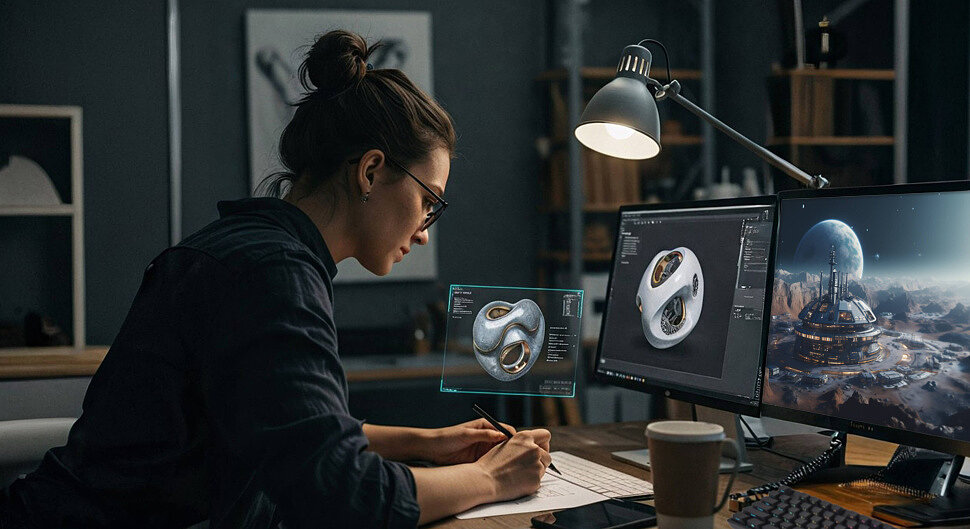
Integrating artificial intelligence into the world of art has opened up a whole range of benefits for artists. First of all, this is significant optimization of workflows. Deep learning algorithms can take on routine tasks such as quickly scaling images, removing noise or even automatically correcting colors. Thanks to this artists save a lot of time and energy which they can channel into creativity itself.
Another significant advantage is incredible prototyping speed. With AI art technologies you can instantly generate several variants of the same idea, compare them and choose the best one. Previously this required a lot of time and manual labor, especially when it came to complex illustrations or concept art. Now a few clicks in the right service are enough to get sketches that can be immediately refined.
The third plus is the opportunity to more easily discover new directions. Artificial intelligence often suggests unexpected variations of colors, shapes and styles, stimulating the artist to creative experiments. Even experienced masters who have worked for years in a particular genre can find something innovative for their development. AI services are a kind of source of inspiration when an artist faces a creative block or wants to move away from classical approaches.
One should also not forget about commercialization prospects. Digital art services based on artificial intelligence allow quick creation of high‑quality banners, illustrations, logos and other graphic materials demanded in marketing, the gaming industry and the IT sphere. Thus, AI for artists becomes a tool for earning and expanding professional contacts.
AI for image generation (2026)
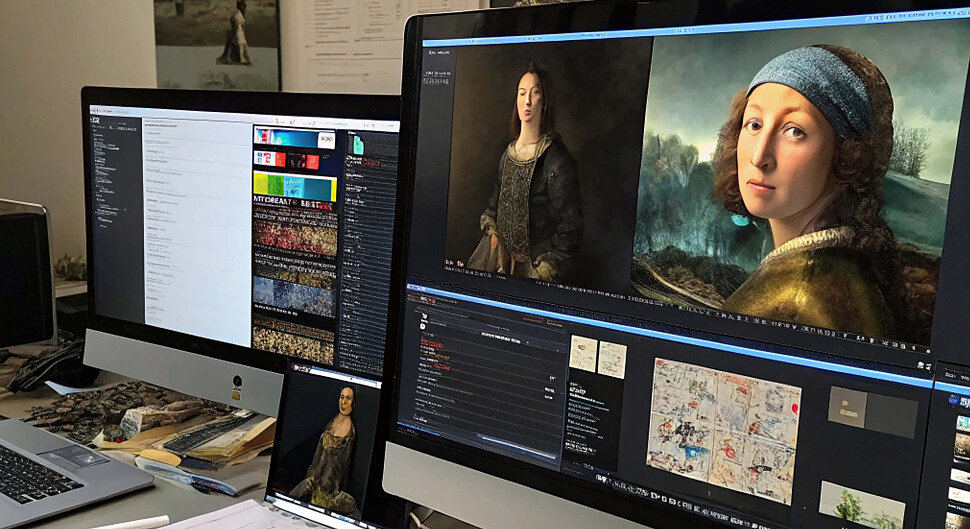
This is the main category of services for an artist – image generation based on a text description (prompt). It is where the most changes have occurred in the last year.
- Midjourney v7 – still the king of aesthetic generation. Ideal for concept art and artistic images. Paid (from $10/month), no free version.
- Flux (from Black Forest Labs) – a new standard of open generation, surpassing Stable Diffusion. Works best with text inside the image. Available free via fal.ai, Replicate, Krea.
- Nano Banana (Gemini 2.5 Flash Image) – a revolution in editing. It can remove an object from a photo, replace the background or change the style without losing the quality of the rest. Free via Gemini.
- GPT‑Image (via ChatGPT) – replaced DALL‑E 2 and 3. Understands text inside the image, preserves style between sessions. Free with limits, unlimited in the ChatGPT Plus subscription.
- Stable Diffusion XL / 3.5 – an open solution that can be deployed locally. Gives maximum control, but requires a powerful graphics card.
- Krea – real‑time generation, combines several models in one interface. Especially good for artists working in collaboration with AI.
- NightCafe – a friendly platform for beginners with a large library of models. Free with limits.
- Artbreeder – “crossbreeding” portraits, landscapes and characters. Convenient for finding unique images and references.
AI for upscaling and quality improvement
When you photograph your painting and want to upload it to Saatchi Art or another marketplace, image quality is critical. These services turn ordinary shots into studio quality.
- Krea Enhancer – the most popular upscaler of 2025–2026. Makes photos photorealistic and adds detail. Paid, but with free credits.
- Magnific – a premium upscaler that not only increases resolution but “draws” additional details. Used by professional artists and designers.
- Topaz Photo AI – local software, best for enlarging old scans of paintings and restoring photos. Paid ($199 one‑time).
- Let's Enhance – a simple online service, free for a few images per month.
- VanceAI – a multi‑tool: noise removal, restoration of old photos, upscaling.
AI for processing painting photos and removing backgrounds
An artist takes a photo of their work in the studio – and the table, reflections, shadows or uneven light are visible. These services quickly clean up the photo and prepare it for the marketplace.
- Photoroom – the de facto standard for background removal. Free via the web, there is a mobile app.
- remove.bg – the oldest and most reliable service. Free with a watermark, without a watermark it costs $0.20 per image.
- Adobe Photoshop (Neural Filters + Generative Fill) – a complete ecosystem for photo correction with AI: remove dust, balance color, add missing edges of the painting.
- Fotor – quick online retouching with AI, suitable when you need to do everything in 5 minutes.
AI for video from your paintings (2026)
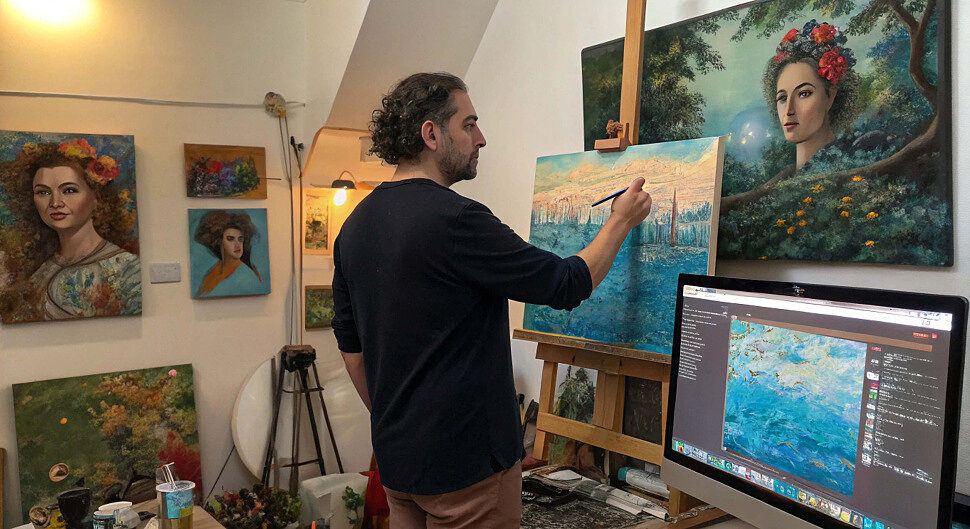
The hottest category of the last 12 months. These services turn your static paintings into videos for Instagram, TikTok and YouTube Shorts – a powerful promotion tool for an artist.
- Sora 2 by OpenAI – the most “cinematic” video generation from text or picture. Available via ChatGPT Pro/Plus subscription.
- Veo 3 by Google – video generation with sound (dialogue, noise). Available via Gemini Advanced.
- Runway Gen‑4 – a premium tool for artists and videomakers. Turns a painting into an animated scene. Paid from $15/month.
- Kling AI – a Chinese competitor to Sora, works great with animation of paintings in the style of “bringing to life.” Free with limits.
- Higgsfield – specializes in complex camera movements and cinematography. Artists use it for beautiful intro videos.
- MyHeritage Deep Nostalgia – “animates” static portraits, including faces in old paintings. Used for art experiments.
AI assistants for text: work descriptions, posts, artist statements
An artist has created a painting – and now needs to write a description for Saatchi Art, a post on Instagram or a biography for a gallery. These services are your copywriters.
- Claude (by Anthropic) – the best AI for long texts in Ukrainian and Russian. Ideal for artist statements, biographies, exhibition descriptions. Free with limits.
- ChatGPT – a universal assistant for social media posts, marketplace descriptions and translation. The free version is sufficient for most tasks.
- Gemini – free, works well with Ukrainian, can analyze a painting image and immediately write a description.
- DeepL – an accurate translator for translating artwork titles, descriptions and correspondence with foreign buyers.
- Jasper Art – a marketing platform for artists, combining copywriting and image generation.
Ready-made prompts for artists (copy and paste)
To get a good result from AI, you need the right prompt. Here are five working prompts you can use right away:
1. Painting description for Saatchi Art (ChatGPT/Claude):
“Write a description for Saatchi Art for the painting “Sunset over the Dnipro”, oil on canvas, 60×80 cm, 2024. The style is impressionism with elements of Ukrainian folk symbolism. Target audience – collectors of interior art in the USA and UK. Description in English, 150–200 words, emotional, mentioning the technique and creation history.”
2. Concept art based on the painting (Midjourney/Flux):
“oil painting style, contemporary Ukrainian landscape, sunset over Dnipro river, golden hour light, impressionist brushstrokes, palette of ochre, burnt sienna and ultramarine, 4K, detailed, --ar 4:5 --style raw”
3. Video from the painting (Sora/Runway):
“Animate this painting: slow camera zoom in towards the center, subtle wind movement in the trees, soft golden light gradually shifts, 5 seconds, cinematic”
4. Artist statement (Claude):
“I am a Ukrainian artist, I have been working with oil for 12 years; my themes are Ukrainian identity, war, hope. I have participated in eight exhibitions in Kyiv and two group shows in Poland. Write me an artist statement in Ukrainian (200–300 words) and its English translation for submission to an international gallery.”
5. Cleaning a painting photo (Photoroom):
Upload a photo → select “Remove background” → then “AI Enhance” to increase sharpness → “Replace shadow” to add a natural shadow → done.
Ethics of AI art: what you need to know about labeling works
This is an important topic for 2025–2026 that many artists ignore – and then they get banned on marketplaces.
- Saatchi Art – requires labeling AI works with a separate tag “AI-generated.” Pure AI art without artistic processing is often rejected by moderators.
- Artsy – sells only works from recognized galleries. AI art is accepted only if there is a clear conceptual justification and the artist is well-known.
- ArtMajeur – introduced a separate category “AI Art,” where works can be sold, but the price is lower than traditional works.
- Etsy – allows AI art, but requires labeling and warns that it does not consider it “handmade.”
- Singulart – effectively prohibits purely AI-generated works.
Safety rule: if you have used AI only as a tool (for reference, concept or photo upscaling), you do not need to label it. If a work is fully generated by AI, be sure to indicate this in the description. Otherwise you risk ending up on the platform’s blacklist.
Practical cases: how artists integrate AI into their workflows
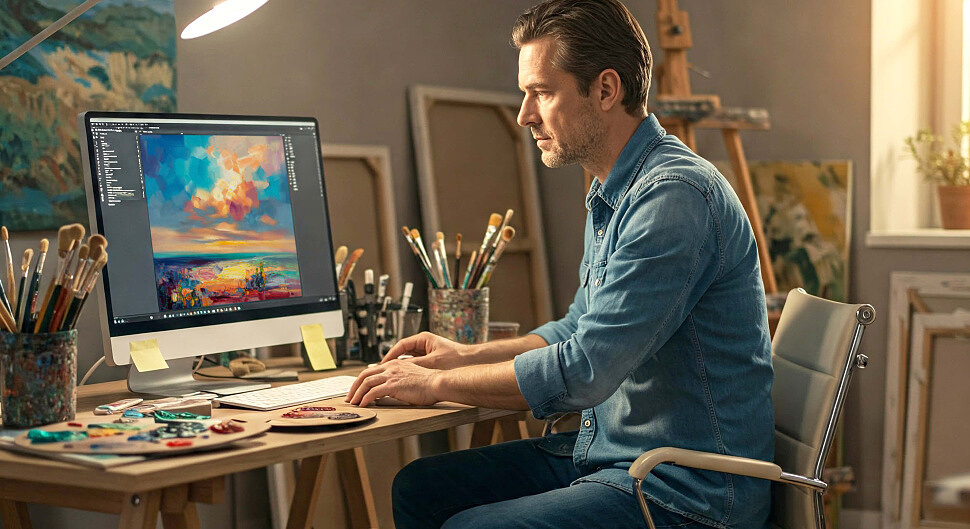
Real examples of artists who successfully use AI clearly demonstrate how flexible the combination of traditional and digital techniques can be. One vivid case is the creation of concept art for video games. Artists often use image generation with Flux or Midjourney to quickly get initial sketches of characters and locations. Then these sketches are refined manually in professional software, such as Photoshop or Clip Studio Paint, where AI again can help with drawing small details or correcting textures.
Another common scenario is digital restoration and recovery of old paintings or photographs. Services like Krea, Topaz Photo AI and VanceAI allow you to restore lost fragments, increase sharpness and brightness without distorting the original artist’s manner. This process used to take several weeks of manual labor and required high qualifications, whereas today it becomes more accessible and faster thanks to AI.
In the field of digital painting, artists often turn to Artbreeder and Nano Banana to create characteristic portraits that later serve as references for painting in oil or acrylic. NFT artists are also increasingly using neural network based tools to diversify token collections: AI generates visual variations, and the author makes the final touches and sells the work as a unique digital asset.
The third case is selling on international platforms. An artist takes a photo of a painting with a phone, processes it in Photoroom (removes the background, levels the light), passes it through Krea Enhancer to improve quality, then asks Claude to write a professional description in English with keywords for Saatchi Art – and after just 15 minutes the work is on sale on an international marketplace.
The future of AI in art and advice for artists
Artificial intelligence continues to evolve at an incredible pace, and its influence on the art world will only intensify. In the near future we can expect more accurate video generation models (Sora 3, Veo 4), integration of AI directly into smartphones (Apple Intelligence is already available on iPhone, Google – on Pixel), as well as the emergence of specialized AI tools for art – not general platforms, but specifically for artists.
On one hand, artists will have more freedom and tools. On the other hand, competition in the digital art sphere will increase, as more and more newcomers will be able to create visually high‑quality works. To stand out it is important to maintain your own voice and style – AI should be a tool, not a replacement for authorial thinking.
Five tips for an artist working with AI:
- Do not rely only on AI – use it for speed, but always refine the final work yourself.
- Master two or three services deeply rather than twenty superficially. Deep mastery of Midjourney or Flux will yield more results than superficial knowledge of all platforms.
- Save prompts that worked – they are your creative capital, like a folder of references.
- Label AI works when selling – this is a matter of reputation and collectors’ trust.
- Keep track of updates – in this niche everything changes every 3–6 months. Subscribe to news from Midjourney, OpenAI and Google.
Frequently asked questions
Which AI service is best for a beginner artist in 2026?
Can AI art be sold?
Will AI replace traditional artists?
How to create a video from your painting for free?
Which AI tools are best for upscaling a painting photo before selling?
Which is better – Midjourney or Flux in 2026?
Can AI be used to write an artist statement?
Do I need to purchase subscriptions for all these services?
How to protect your paintings from being copied by a neural network?
Will AI help to appraise my painting?
Which AI services will come in handy when selling paintings abroad?
Our materials on the topic may also be useful:
- Appraise a painting online from a photo – does AI help?
- Top online galleries for selling paintings abroad
- Artist résumé – how to write it correctly
- Free invoice generator for artists
Have questions? We will be happy to consult you +38 063 247 8102
Or write to us on Telegram, Viber or WhatsApp
You may be interested in the following services of our gallery
Export of paintings abroad (obtaining a permit)