



Collectible and interior paintings: what's the difference and what is investment painting?
 Art DomFebruary 1, 2026
In this article, we will compare art market trends over the last decade, analyze the opinions of leading auction houses, and examine the reality of art prices. We will also answer popular questions from art dealers and artists: which paintings are considered collectible? Is there a direct correlation: the more meaning, the more expensive the canvas? And what is the formula for pricing the "Blue Chips" of the art world?
Reading time — 10-12 minutes
In the art world, there is no question more popular and simultaneously more dangerous than this one: "Is this just a painting for the interior or is it already collectible art?". Intuitively, it seems simple. Interior painting is "beautiful," collectible is "smart," and investment is "expensive." But the real art market over the last 15 years has proven: these categories do not overlap 100% and are not required to overlap at all. The art market does not divide the world into black and white but plays in a spectrum of grey shades, where context is more important than genre, and the artist's biography is more important than the buyer's aesthetic preferences.
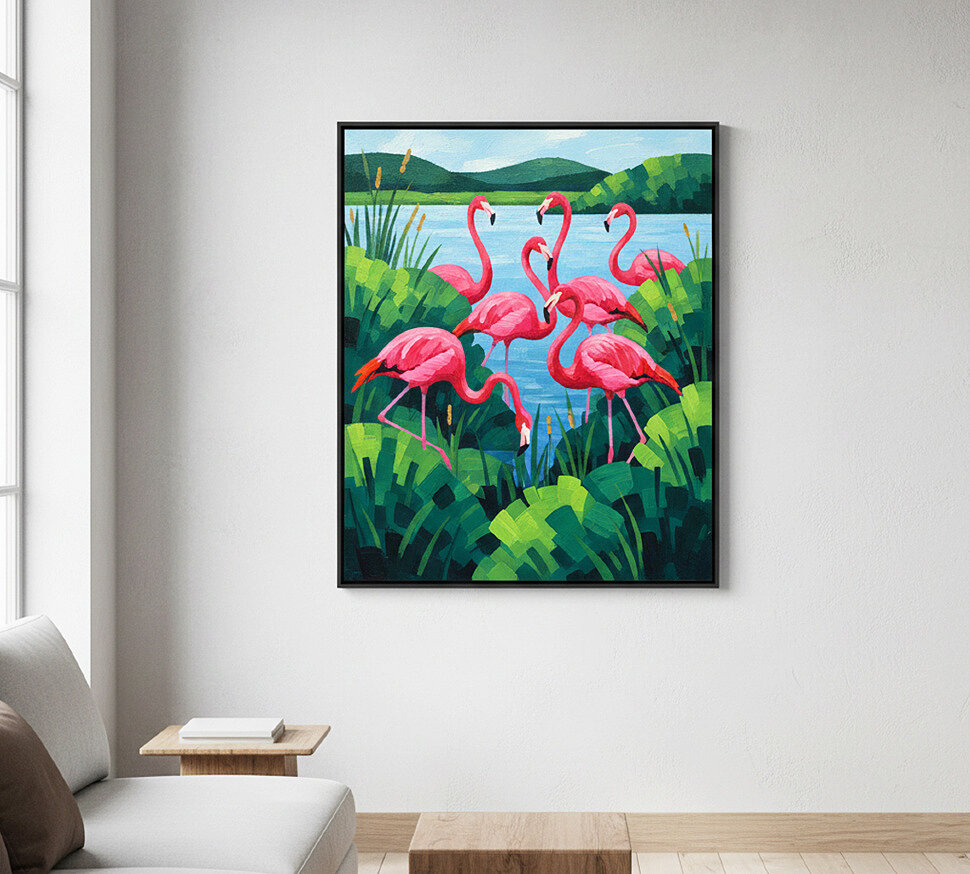
What is an interior painting really?
Contrary to popular belief, "interior painting" is not an insult and not a synonym for secondary or "cheap" art. It is more correct to say: interior painting is a work created (or acquired) primarily for harmonious coexistence with the space.
Its key features:
- visual clarity and aesthetics;
- emotional "accessibility";
- absence of harsh conceptual conflict or shock content;
- universality (comfortable for different viewers).
It is important to understand: interior quality is not a characteristic of quality (bad/good), but a characteristic of function (harmonization of space).
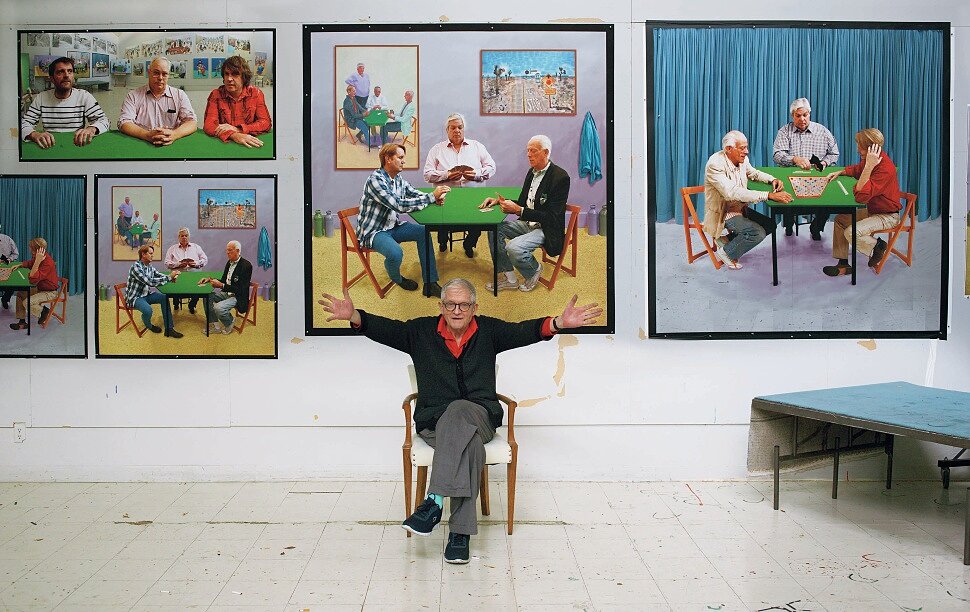
Market Example: The Case of David Hockney
David Hockney's works from the 1960s–1970s "live" perfectly in interiors: clean colors, pools, understandable subjects. Yet their value has grown phenomenally. The iconic painting Portrait of an Artist (Pool with Two Figures) from 1972, which was valued at $5–10 million in the early 2000s, was sold for $90.3 million at Christie's in New York in November 2018. At that time, it became a record price for a work by a living artist.

Over the last 20 years, prices for Koons' works have grown multifold, which is explained by a combination of factors far from "philosophy":
- the artist's famous personal brand;
- visual simplicity and instant "readability" of images;
- a long path of institutional recognition (museums, biennials, art foundations);
- scarcity in the secondary market (works rarely appear for free sale).
What do galleries call collectible painting?
In top galleries in London, New York, or Basel, the term collectible art does not mean a style or format, but the degree of the work's inclusion in the professional artistic discourse.
A collectible painting almost always:
- is part of the author's research or specific period;
- is connected to a specific series or project;
- has a recorded exhibition history (provenance);
- is read within the context of art history, not just visually.
Yes, such works often contain symbolism, surreal elements, irony, satire, or criticism of social themes. But the key here is not the "complexity" of the image, but the artist's position. There are thousands of authors creating incredibly complex, gloomy, philosophical canvases full of symbolism. Their price often freezes at the $2,000–$5,000 mark and does not grow for years.
Conclusion: The market does not pay for "depth of meaning." The market pays for innovation (who did it first?), brand (recognition by museums and top galleries like Gagosian or White Cube), and recognizability.
Collectible painting can be conceptual, but this is not a mandatory condition for a high price. Rothko is color. Banksy is straightforward satire. Both are investment "Blue Chips."
Myth: "The more complex the meaning, the more expensive the painting"
This is one of the most harmful myths for a novice collector. Facts suggest the opposite:
- Over the last 10 years, the most stable growth (according to Christie’s and Sotheby’s data) was shown by artists with a recognizable, visually strong, and relatively "readable" language.
- Excessively radical conceptual works often grow in price erratically and unstably.
- Collectors increasingly choose a balance between meaning and aesthetics. That is why many "heavy" conceptual works are difficult to sell on the secondary market without a discount.
Investment Painting = Collectible?
Not always. Investment painting is a narrow segment of collectible art that possesses high liquidity.
Investment Potential Formula:
Investment = (Talent + Media Presence + Scarcity) × Time
Can a "simply beautiful" painting become an investment? Absolutely. Remember the Impressionists. At the end of the 19th century, for academics, Monet and Renoir were creators of "unfinished sketches," while "serious art" was considered to be historical canvases with moral subtext. Today, those "serious" canvases gather dust in storage, while Monet's "interior" water lilies cost hundreds of millions.
A painting becomes an investment if:
- the artist has a confirmed market (sales at auctions, not just in the studio);
- there is positive price dynamics over distance, not a one-time "hype";
- there is institutional support;
- the work is typical for the author's "strong" period.
Real Trends of the Last 10 Years
- USA and Europe: Price growth for New Figurative Painting. Medium-format works that easily integrate into private interiors turned out to be more liquid than complex installations.
- Asia: Artists with a "quiet concept" (Dansaekhwa, Japanese minimalism) showed steady growth.
- Eastern Europe: Interest is shifting towards artists combining a strong visual image with a local cultural code, but without intrusive declarativeness.
Summary: The World is Not Divided into "Just Decor" and "Museum Masterpieces"
The art world is like a layer cake:
- On the bottom layer — mass-market decor. These are "fast carbs" for the eyes.
- In the middle — promising authors. Here, the interior can become great, and the collectible can depreciate. This is a zone of risk and excitement.
- At the top — Blue Chips (Warhol, Richter, Hockney). Here it no longer matters whether it is beautiful or not. It is currency.
Our advice to collectors: buy with your eyes, but verify with facts and figures. If a painting evokes an emotion in you — it is art. If it simply matches the color of the curtains — it is decor. Both have the right to be in your home. But only the first will preserve capital.
Leading art critics today agree on one thing: the value of a painting is born not at the moment of its creation, but in how long and for whom it remains significant.