


Pallets and Sealing: New Requirements for Heavy Art Shipments
 Art DomAugust 3, 2026
Consignments weighing more than 50 kg must be shipped on a pallet, which provides the clearance needed for pallet trucks and forklifts. The consignment must also be sealed.
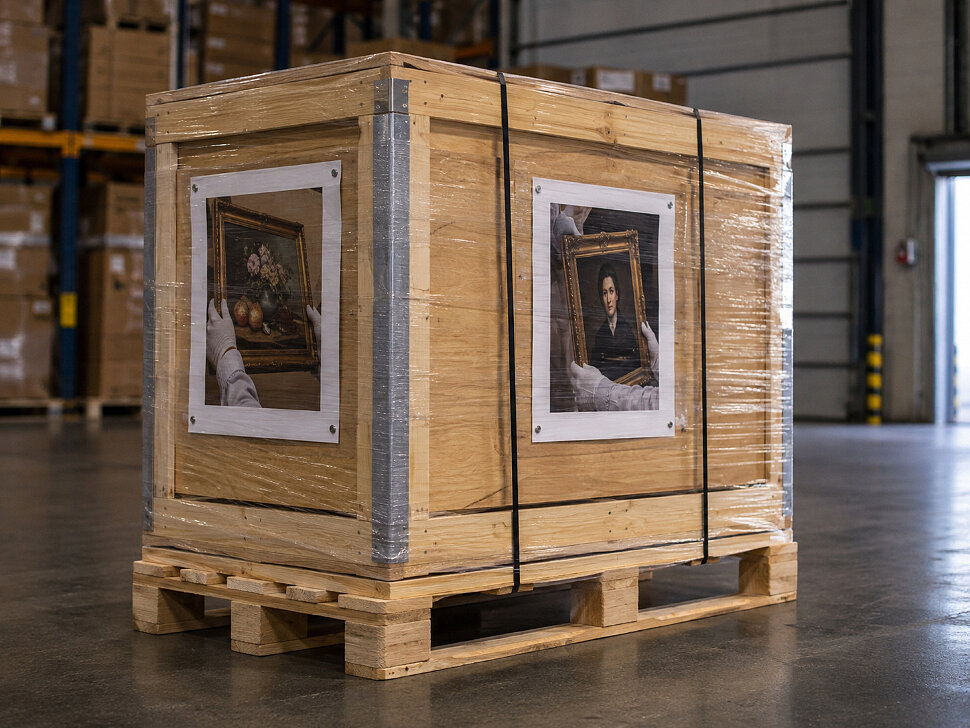
For heavy art consignments a pallet provides stability, allows safe handling with a pallet truck or forklift, and reduces the risk of damage to the packaging.
Why a pallet, rather than simply a crate on the floor of the vehicle
The reason is that a shipment travelling abroad passes through several sorting centres and is transferred between vehicles along the way. To move consignments quickly, transport companies use forklifts, which means the load needs clearance underneath so it can be picked up and moved without damage. That is exactly what a pallet provides.
International logistics follows an informal but very widely applied benchmark: if a single unit of cargo weighs more than 34 kg (75 lb), it should go on a pallet — even when it is one crate rather than a batch of goods. The most common standard in Europe is the EUR/EPAL pallet at 1200×800 mm; international air and ocean freight also make wide use of the 1200×1000 mm size. It matters that the pallet dimensions match standard container openings and the requirements of the destination country — otherwise the consignment may be refused at the loading stage.
| Parameter | Benchmark | What to bear in mind |
|---|---|---|
| Consignment weight | Over 50 kg | A pallet is mandatory under heavy freight terms |
| Practical benchmark | From 34 kg / 75 lb | Many carriers already require palletisation of a single heavy unit |
| EUR/EPAL | 1200×800 mm | The most common format in Europe |
| International format | 1200×1000 mm | Frequently used in air and ocean logistics |
| Height | Around 150 cm | Taller stacks are less stable for standard transport |
Wooden pallets, like wooden crates, are also subject to mandatory phytosanitary treatment under the ISPM 15 standard when crossing a border — without the corresponding stamp, a pallet can be rejected at customs.
Seals: not a formality but a security requirement
Sealing a consignment confirms that no one has had access to it since dispatch. In international logistics, seals are classified into three levels of integrity under the ISO 17712 standard: indicative, security and high security. For shipments to the United States, companies operating under the CTPAT customs security programme (Customs-Trade Partnership Against Terrorism) are required to use high security seals — which covers virtually all major international carriers, including UPS, FedEx and DHL.
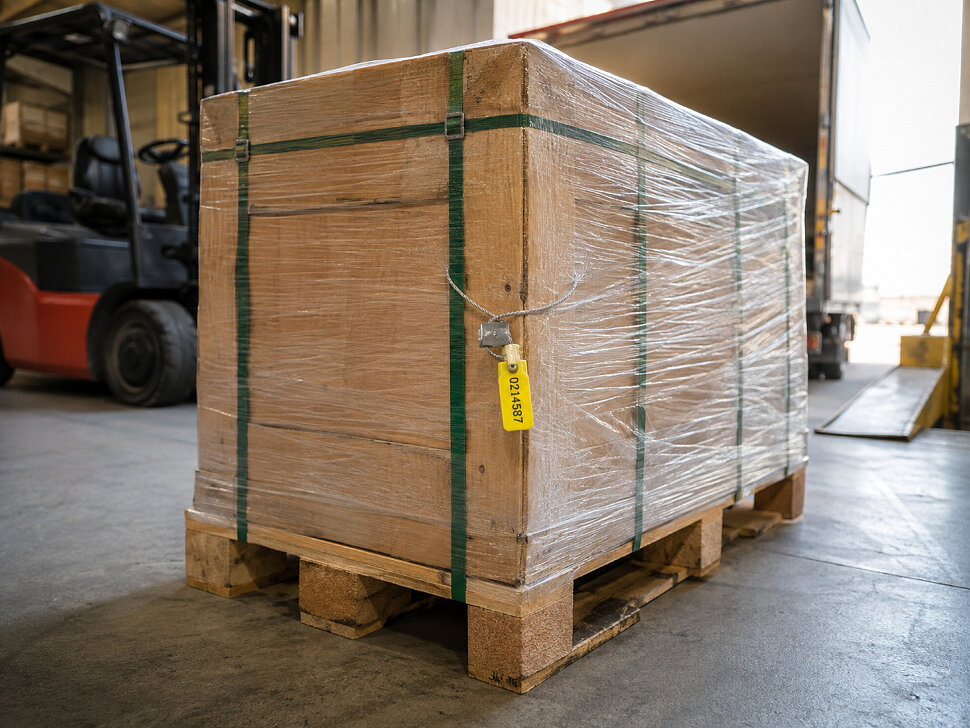
A numbered seal makes it possible to verify the integrity of the packaging: its number is recorded in the transport documents and checked at each stage of the journey. The seal number must be recorded on the waybill — this allows the integrity of the consignment to be verified at every stage as it moves between sorting centres. In short: heavy consignments go on a pallet, the dimensions and timber treatment are checked, and the load is secured and sealed with the seal number entered in the documents.
Practical advice before shipping
— check that the load is evenly distributed across the pallet and firmly secured with stretch film or strapping — a carrier may refuse an unstable or shifted consignment;
— the maximum safe load height on a pallet is around 150 cm; taller stacks are considered unstable for standard transport;
— photograph the packed consignment and the seal number before dispatch — this serves as evidence should a dispute with the carrier arise;
— confirm the requirements of your specific transport company in advance, because there is no single universal international palletising standard — every carrier applies its own internal instructions on top of the general ISPM 15 and ISO 17712 requirements.
International carriers regularly update their rules for oversized consignments — so before shipping it is important to confirm the current palletising and sealing requirements with your specific carrier.