


New EU and Polish Rules in 2026: What Changed for Shipping Paintings via UPS
 Art DomAugust 18, 2026
Most shipments of artwork from Ukraine to the United States and Western Europe transit through Poland. In 2026 two regulatory regimes changed there at once — the EU-wide pre-arrival declaration system ICS2 and Poland's transport monitoring system SENT. Here is what applies to paintings, and what does not.
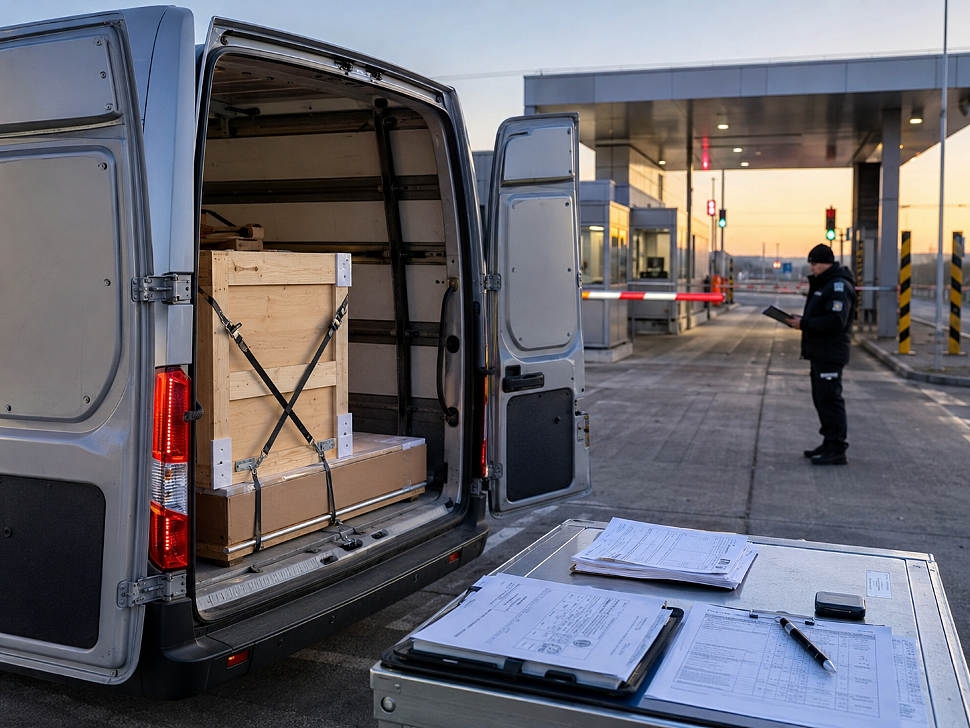
When transiting through Poland it is important to prepare the shipment details in advance: the HS code, an accurate description, the consignee's data and the documents for pre-arrival declaration.
ICS2 version 3: pre-arrival declarations are now mandatory for everyone
Since 3 February 2026, version 3 of the Import Control System 2 has been mandatory across all transport modes. Messages in the old format (v2) are rejected by the ICS2 Common Repository from that date — which means the shipment simply does not move.
For Poland the key date came later: on 1 June 2026 Poland, together with Croatia, Latvia, Romania and Slovakia, completed the final phase of the ICS2 rollout for road transport. After that date the legacy ICS1 system was fully decommissioned across all EU countries and all transport modes.
What this means in practice. For every consignment entering or transiting the EU, an Entry Summary Declaration (ENS) must be filed before the goods reach the border — and for road transport, no later than one hour before crossing. The declaration must include:
— a six-digit HS code for each commodity line on the commercial invoice;
— a detailed description of the contents (generic wording is not accepted);
— the consignee's EORI number;
— net weight per code, where more than one code applies.
| What the ENS requires | What to state |
|---|---|
| HS code | A six-digit code for each commodity line |
| Description | A specific description of the contents in English |
| EORI | A valid consignee number |
| Net weight | Separately per code, where more than one code applies |
Stop words: why "artwork" can sink your declaration
ICS2 automatically rejects declarations containing so-called stop words — descriptions that are too generic or uninformative. An updated list of these words came into force on 3 August 2026 and is published in the European Commission's CIRCABC library.
The practical takeaway for galleries and artists: descriptions such as "goods", "items", "samples" or simply "art" will be rejected. A correct description looks different — for example, "original oil painting on canvas, unframed, 1 pc" together with code 9701. If you use a saved description template in your shipping system, it is worth checking it against the current list.
| Poor description | Correct version |
|---|---|
| art | original oil painting on canvas, unframed, 1 pc |
| goods | original graphic print, signed, 1 pc |
| items | handmade ceramic sculpture, 1 pc |
| samples | a description of the material, technique and quantity of the specific work |
SENT: does it apply to paintings?
There is a lot of confusion about this in logistics circles, so let us be direct: works of art are not covered by SENT.
SENT (System Elektronicznego Nadzoru Transportu) has operated in Poland since 2017 and covers so-called sensitive goods — fuel, alcohol, tobacco, lubricating oils, solvents and certain chemical products. On 17 March 2026 the list was expanded to include clothing and footwear (Combined Nomenclature chapters 61, 62 and 64, plus CN code 6309 00 00 for used clothing). In June 2026 the weight thresholds for these categories were raised.
Paintings, works on paper and sculpture do not fall under SENT. Moreover, a regulation of the Polish Ministry of Finance specifically exempts from SENT reporting any transport carried out by Polish and EU postal operators in registered items weighing up to 31.5 kg.
The conclusion: if someone tells you that a shipment of paintings "falls under SENT", ask which CN code they mean. In all likelihood they are referring to a general tightening of controls on transit routes, not to a specific legal requirement.
| System | Applies to paintings? | What matters |
|---|---|---|
| ICS2 | Yes | A pre-arrival ENS is required: HS code, accurate description, EORI and weight |
| SENT | No | Paintings, works on paper and sculpture are not on the sensitive goods list |

Sealing and the integrity of the security chain
The sealing requirement, by contrast, is real — it simply stems from aviation security rather than from SENT. UPS, FedEx and DHL operate as Regulated Agents and must be able to confirm that no one accessed the shipment after it cleared security screening.
If a crate was opened or repacked in Poland — for instance, to bolt it onto a pallet — the security chain is considered broken, and the carrier requires each unit to be re-sealed with numbered seals, with the numbers recorded on the waybill. If the goods entered Poland under T1 customs transit, the seals must be applied by the customs authority or an authorised consignor.
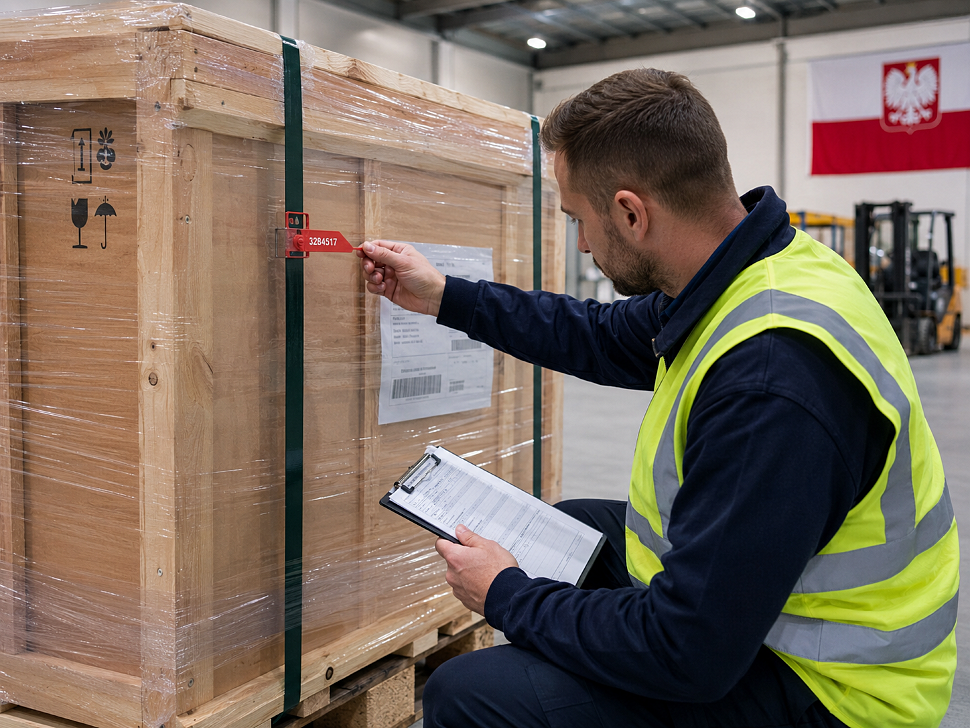
If the packaging was opened or repacked, the carrier may require re-sealing, with the seal number recorded in the documentation.
What to do before shipping
— determine your HS codes in advance and prepare an accurate description of the contents in English;
— confirm that the consignee holds a valid EORI number (for commercial shipments to the EU);
— ask your carrier whether your own numbered plastic seal is sufficient, or whether sealing at a customs warehouse is required;
— bear in mind that a heavy palletised consignment moves from the Small Package category into Worldwide Express Freight — a different division with its own paperwork and requirements.