



Protective packaging for oversized paintings: new requirements for 2026
 Art DomJuly 31, 2026
The leading international carriers — FedEx, UPS, DHL — regularly update their rules for oversized consignments. For artists, galleries and collectors these changes have a direct bearing on the cost, transit time and paperwork involved in shipping paintings abroad.
Shipping larger consignments of artwork — paintings, works on paper, sculpture, and particularly anything over 100×100 cm — requires purpose-built protective packaging. In such cases a crate is made from hardboard, plywood or OSB panels. This increases the dimensions and weight of the consignment, but it ensures the work arrives intact and undamaged.
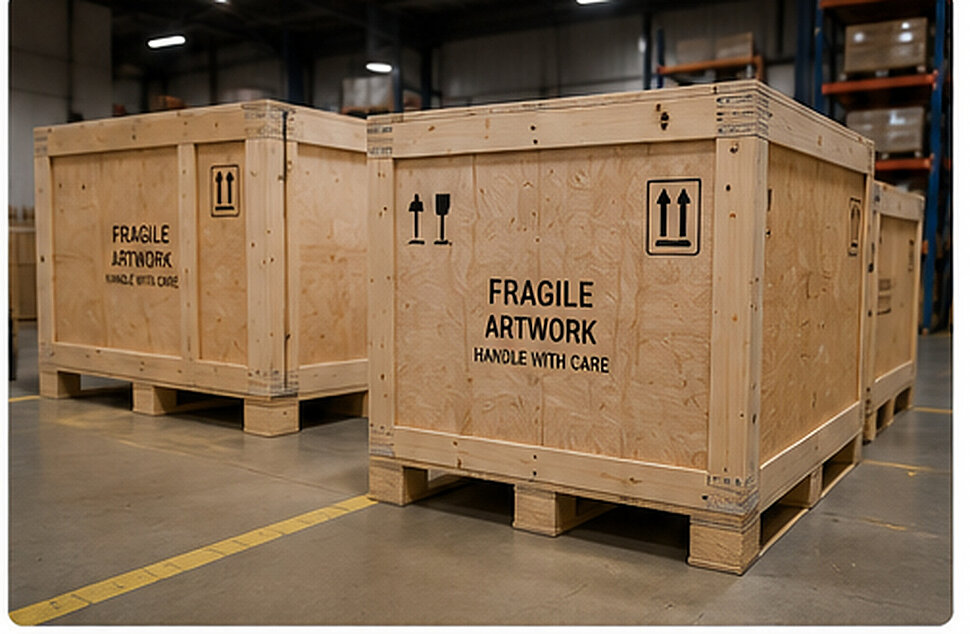
Large-format works travel in rigid crates, which protect the piece during handling, vibration and accidental impacts.
Why a wooden crate rather than an ordinary box
A wooden crate distributes impact and vibration across the whole structure rather than through the corners of the canvas or frame, which is what happens with cardboard packaging. For large-format works this is critical: in air or road transport the consignment is transferred several times between different vehicles, and it is at precisely these moments that damage most often occurs.
| Packaging element | What it does | Practical benchmark |
|---|---|---|
| Wooden crate | Protects against impact, pressure and vibration | Particularly important for works from 100×100 cm and heavy objects |
| Acid-free contact layer | Keeps the paint layer from direct contact with the packaging | Acid-free, silicone or glassine paper |
| Spacers and corner protectors | Hold the work in place inside the crate | The frame must not shift when tilted or vibrated |
| Runners underneath | Allow safe handling with a forklift | Clear access is needed for the forks |
The mandatory international standard ISPM 15
If the crate is made of timber (including plywood or hardboard containing a wood component), it must be treated under the international phytosanitary standard ISPM 15 — heat or chemical treatment of the timber against pests and insect larvae. Without the ISPM 15 stamp on the crate, customs authorities in many countries, including the EU, the United States and the United Kingdom, are entitled to hold the consignment or require treatment at the border, which means additional time and expense. It is therefore worth having the crate built by a workshop that already holds the relevant certification.
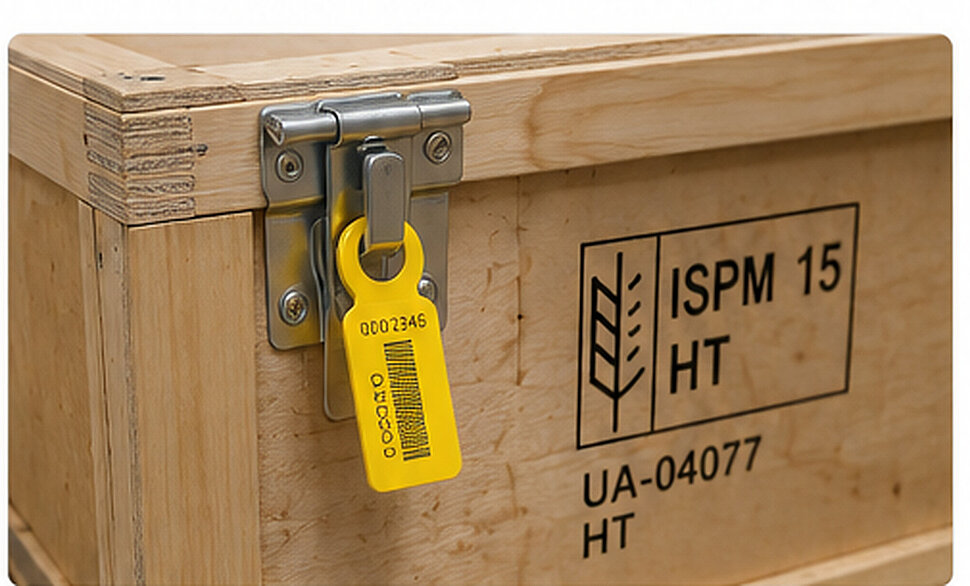
Before dispatch, check that the ISPM 15 stamp is legible and, if your carrier requires sealing, record the seal number in the documents and in a photograph.
What else goes into professional packing
Beyond the crate itself, proper protection for a painting depends on:
- the soft wrapping in direct contact with the surface of the work — this must be acid-free paper or silicone or wax ("glassine") paper, not ordinary bubble wrap pressed against the paint layer, which can stick to impasto brushwork;
- internal spacers and corner protectors, which hold the frame in place and stop the canvas moving around inside the crate in transit;
- runners (projections underneath) on the crate itself — so that a forklift can pick up the consignment without risk of damaging the contents;
- markings on the crate with clear orientation instructions ("this way up", "do not turn over", "fragile") — not a formality but a genuine guide for handlers at every sorting point.
For particularly valuable or vulnerable works (aged oil paint, work on panel, canvas with an unstable ground) the packing also has to account for temperature and humidity swings in transit — sharp fluctuations can crack the paint layer even with perfect physical protection.
Customs factors also affect the packing
Every country has a customs service, and customs policy changes constantly. When shipping artwork abroad you therefore need to take account of all these factors, which affect the cost of delivery, the transit time and any additional expenses — the payment of customs charges in the country of arrival, for instance.
ArtDom Gallery helps prepare artworks for international shipping: professional packing in compliance with the ISPM 15 standard, and advice on carriers' current requirements.