


Tachographs for Vans in the EU from 1 July 2026: What It Means for Shipping Paintings
 Art DomAugust 19, 2026
From 1 July 2026 the requirement to fit a tachograph extends to light commercial vehicles between 2.5 and 3.5 tonnes used for international goods transport. These are precisely the vehicles most often used to move paintings and sculpture into Europe — so the change bears directly on art logistics.
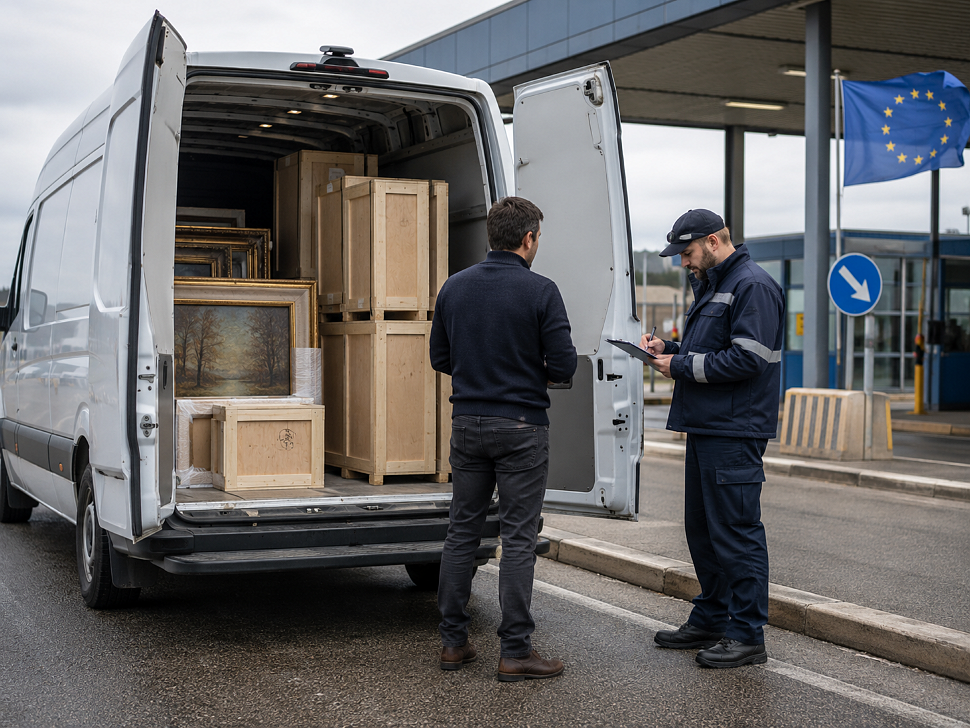
Vans are widely used for the individual transport of paintings and other large-format works of art.
Who is actually affected
Let us be precise, because in industry discussion this is often reduced to "everyone now needs a tachograph". That is not the case. The requirement applies only when three conditions are met at the same time:
— the maximum authorised mass of the vehicle (or of the vehicle and trailer combined) exceeds 2.5 tonnes but does not exceed 3.5 tonnes;
— the transport is commercial, that is, for hire or reward;
— the journey is international within the EU, or constitutes cabotage — delivery inside a member state where the carrier is not established.
| When a tachograph is mandatory | ||
|---|---|---|
|
2.5–3.5 t
Maximum authorised mass of the vehicle or combination
|
Commercial
The transport is carried out for hire or reward
|
EU / cabotage
International route or cabotage operation
|
| All three conditions met at once — a tachograph is required. | ||
A 3.2-tonne van operating only within a single country falls outside the requirement. The same van, crossing a border even once a month, falls squarely within it.
An important detail: what counts is the mass stated in the vehicle documents, not the actual weight at a roadside check. And if the vehicle tows a trailer, the combined permissible mass of the set applies — which can bring even a car with a heavy trailer into scope, provided the transport is commercial.
Which device is required
Only a second-generation smart tachograph, version 2 (Smart Tachograph G2V2), will comply. Analogue and earlier-generation digital tachographs do not meet the requirements — primarily because they lack satellite positioning and remote data-reading functions.
| Device type | Compliant after 1 July 2026 | Comment |
|---|---|---|
| Smart Tachograph G2V2 | Yes | Meets the new requirements |
| Older digital tachographs | No | Lack the full functionality of the new generation |
| Analogue tachographs | No | Do not meet the G2V2 requirements |
Along with the device, drivers become subject to the driving and rest time rules of Regulation (EC) 561/2006 — the same rules that have applied to heavy goods vehicle drivers. Posting declarations for drivers and stricter cabotage controls also come into play.
Where the requirement comes from
This is not a decision taken this summer. The rule forms part of Mobility Package I, adopted back in 2020 and phased in over several years. Until 1 July 2026 the tachograph threshold stood at 3.5 tonnes; it has now been lowered to 2.5 tonnes for cross-border commercial transport.
Industry estimates put around three million light commercial vehicles across Europe within the new scope. These are common models — Mercedes Sprinter, Ford Transit, VW Crafter, Renault Master, Peugeot Boxer: most have a permissible mass of 2.5 tonnes or more, and considerably more with a trailer.
Exemptions
EU law provides several exemptions, of which the so-called craftsman exemption (Article 3(aa) of Regulation 561/2006) is potentially of interest to the art sector. It excludes from the driving time rules the carriage of materials, equipment or machinery the driver needs for their work, as well as the delivery of goods produced as part of a craft activity.
The conditions must all be met simultaneously, however: a permissible mass of up to 7.5 tonnes, transport within a 100-kilometre radius of the company's base, driving not being the driver's main occupation, and the transport being ancillary to the company's core business. For international art shipments covering hundreds of kilometres, this exemption will generally not apply.
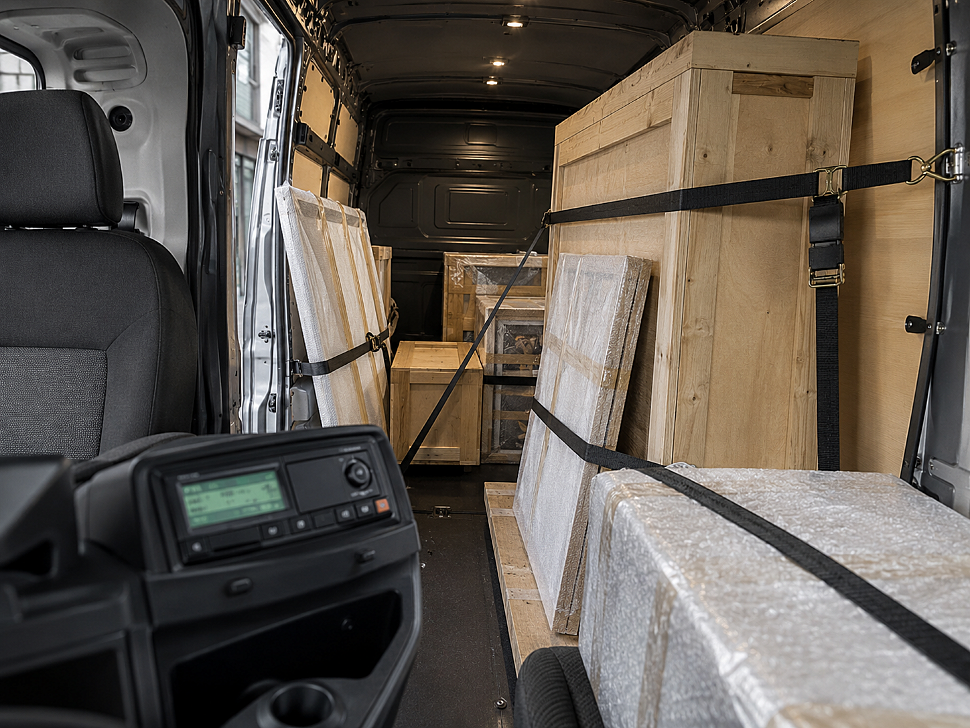
International art delivery depends not only on packing and securing the load, but also on compliance with the rules governing the vehicle and the driver.
What this means for cost and transit times
The consequences for the market are predictable. Carriers who previously moved consolidated loads in vans without tachographs and without driving time limits must now retrofit their vehicles, obtain driver cards and work within driving and rest rules. That means:
— higher prices for light transport on European routes;
— longer transit times, since a driver can no longer simply keep going;
— less flexibility on urgent shipments, particularly over long distances.
| Change | What it means for the client |
|---|---|
| Retrofitting vehicles | The carrier's additional costs may be built into the rate |
| Driving and rest rules | On long routes, delivery may take more time |
| Stricter enforcement | Less scope for urgent or non-standard schedules |
Practical advice for galleries and artists: if you are planning to take part in a fair or exhibition in Europe, allow more time for logistics than you did last year, and fix the transport price in advance. A few days' difference at the border now costs more than it used to.